A 2026 SMB Game Plan for Multicloud Cost Management, Governance, And Quick Wins
If you run a small business and your cloud bill keeps creeping up, you’re not alone—and you don’t need a giant IT program to fix it. This 2026 plan shows how SMBs can rein in spend across AWS, Azure, Google Cloud, and SaaS with practical multicloud cost management steps you can action quarter by quarter. We’ll blend proven FinOps practices with a simple cadence—Q1: clean up, Q2: consolidate, Q3: optimize—so you can control costs without slowing the business.
Gallop Technology Group helps small businesses and owner-led firms do exactly this—tighten costs while improving reliability. Our services include secure cloud server hosting, Microsoft 365 management, backup and disaster recovery, helpdesk support, network security, and fractional CTO guidance—all designed to simplify operations, reduce waste, and safeguard client data. If you’d like a hands-on partner to set up a right‑sized, multi cloud cost management program, we’re here to help. Give our team a call at (480) 614‑4227 and get your free IT assessment.
Why a Quarterly Action Plan Works for SMBs
Perfection is the enemy of progress. In smaller teams, the winning move is consistent in control: do a focused sprint, measure savings, then move to the next sprint. The FinOps Framework backs this iterative approach—Inform → Optimize → Operate—which maps neatly to cleanup → consolidation → optimization for SMBs. You don’t need enterprise tooling to start; you need clear visibility, accountability, and a lightweight governance loop.
What’s pushing costs up? Surveys through 2025 show managing cloud spend remains a top challenge, with many organizations reporting budget overruns and material waste from idle resources and underused licenses. As a result, more teams formalized FinOps and adopted MSP partners for help. These trends are especially relevant to SMBs that don’t have in‑house cloud finance expertise.
Q1: Cleanup—get Visibility, Stop Waste, and Eliminate “Zombie” Spend
Start with the fastest payback: finding and fixing what you already pay for but don’t need.
1) Centralize cost visibility across clouds and SaaS.
Unify AWS, Azure, GCP, and SaaS billing into one view. If you can’t add a third‑party tool today, leverage native options and open standards. Microsoft’s FinOps hubs approach can ingest multi‑cloud data and align to the FOCUS (FinOps Open Cost and Usage Specification) standard, which normalizes provider billing, so you can compare apples to apples.
2) Label and tag everything.
Create a simple tagging policy (owner, application, environment, cost center) and make it mandatory for new resources. Unified tagging across providers is a cornerstone of FinOps maturity because it enables allocation, showback/chargeback, and focused cleanups.
3) Audit idle and oversized resources.
Most waste hides in idle services, over‑provisioned instances, unattached storage, old snapshots, and long‑running dev/test. Rightsizing and cleanup can drive double‑digit savings, especially when combined with scheduling non‑production shutdowns.
4) Tackle SaaS sprawl and unused licenses.
Studies across 2024–2025 show that underused or unused SaaS is widespread, with many orgs carrying duplicate tools and inactive seats. Do a quick “app census,” shut off dormant accounts, and consolidate tiers. Even small teams can uncover meaningful savings within a month.
Outcome for Q1: a single cost view, enforced tagging, and a trimmed footprint across cloud and SaaS—plus immediate savings you can bank.
Q2: Consolidation—standardize Tools, Commitments, and Governance
Once the obvious waste is gone, simplify your stack and lock in better rates.
1) Consolidate tools and normalize reporting.
Fewer platforms mean fewer contracts, fewer logins, and clearer reporting. Align billing feeds to the FOCUS standard where possible so your finance view stays consistent as you scale.
2) Establish lightweight FinOps governance.
Adopt a monthly “FinOps stand‑up” with an owner from the business and the technical side. Use the FinOps lifecycle to track progress: visibility targets, optimization backlog, and run‑rate savings. Keep it light but consistent.
3) Lock in compute discounts safely.
For your steady workloads, use Reserved Instances and Savings Plans to reduce per‑hour costs—common discounts reach ~50–75% vs. on‑demand depending on model and term. Keep commitments flexible where your usage is variable, and blend with Spot/Preemptible capacity for burst or batch jobs.
4) Standardize environments and patterns.
Pick a small set of instance families, storage tiers, and data services that fit your typical use. Standardization reduces surprises and makes cloud cost control for SMBs repeatable across teams.
Outcome for Q2: fewer vendors and tools, a cadence for decision‑making, and locked‑in rate reductions without adding overhead.
Q3: Optimization—engineer For Efficiency and Keep Savings Compounding
With the house in order, optimize architecture and operations so savings become continuous.
1) Rightsize as practice, not a project.
Make rightsizing part of your monthly routine. Use native recommendations (e.g., AWS Compute Optimizer) and move workloads to modern chip families (like ARM/Graviton where supported) to reduce cost per performance. Many teams see ~25% compute savings from rightsizing alone; more if they modernize instance families.
2) Automate schedules and lifecycle policies.
Turn off dev/test after hours, scale production based on real demand metrics (not just CPU), and apply storage lifecycle rules so cold data lives on cheaper tiers. Azure, AWS, and GCP all provide native tools to do this safely for SMBs.
3) Embed cost KPIs in how you ship.
Track simple unit metrics (e.g., cost per order, cost per active user) next to reliability KPIs. The FinOps community emphasizes shared ownership and timely, accessible data; when teams see both performance and cost together, better choices follow.
4) Keep SaaS lean and governed.
Set a quarterly license review, auto‑deprovision on off‑boarding, and require approvals for new tools. Zylo’s 2025 data highlights under‑utilization and duplicate subscriptions—governance keeps bloat from creeping back.
Outcome for Q3: continuous savings via automation and engineering choices that balance performance with cost.
What “Good” Looks Like for SMBs in 2026
Consistent visibility.
A single, normalized view of cloud and SaaS, tagged and allocated to owners or cost centers. Microsoft’s FinOps guidance and FOCUS make this achievable without enterprise overhead.
Measured commitments.
Coverage targets for Savings Plans/RIs that match your baseline usage—enough to save, not so much that you risk underutilization—plus a habit of reviewing changes in AWS commitment policies that affect resellers and MSP scenarios.
Lean SaaS portfolio.
Each tool has a clear owner, tier, and renewal date; licenses align to active users, and duplicates are eliminated. Multiple 2025 reports show heavy waste from idle seats—SMBs can reverse that trend quickly with quarterly reviews.
Repeatable rituals.
A monthly 30‑minute FinOps check‑in: compare spend to forecast, review anomalies, approve backlog items (e.g., rightsizing tasks, commitment buys, SaaS renewals), and log realized savings. This aligns with the FinOps Operate phase’s emphasis on continuous improvement.

Practical Tactics You Can Apply This Month
1) Set a “stop the bleed” goal for 30 days.
Pick a number (say, reduce this month’s run‑rate by 10%). Remove unattached volumes, idle IPs, stale snapshots, and non‑production VMs after hours. You’ll see savings in your next bill.
2) Create a simple tagging policy and enforce it.
Even three tags—owner, environment, purpose—unlock accurate reporting and cleanup. It’s the backbone of multicloud cost management for small teams.
3) Start with one safe commitment.
Identify your most stable workload and purchase a conservative Savings Plan (e.g., 12‑month term) to test the process and realize immediate savings.
4) Run a SaaS license day.
Export logins and activity, disable inactive accounts, and merge duplicate vendors. Expect fast wins—many SMBs find double‑digit percentage reductions on renewals.
5) Normalize your cost data.
If you use Azure, explore FinOps hubs for multi‑cloud cost reporting (including GCP) based on FOCUS datasets. This makes comparisons clearer and conversations faster.
You don’t need perfection to win—consistent control will do. Start with cleanup, consolidate the noise, then optimize what remains. Put these steps on a quarterly cadence, and your savings will compound through 2026 and beyond.
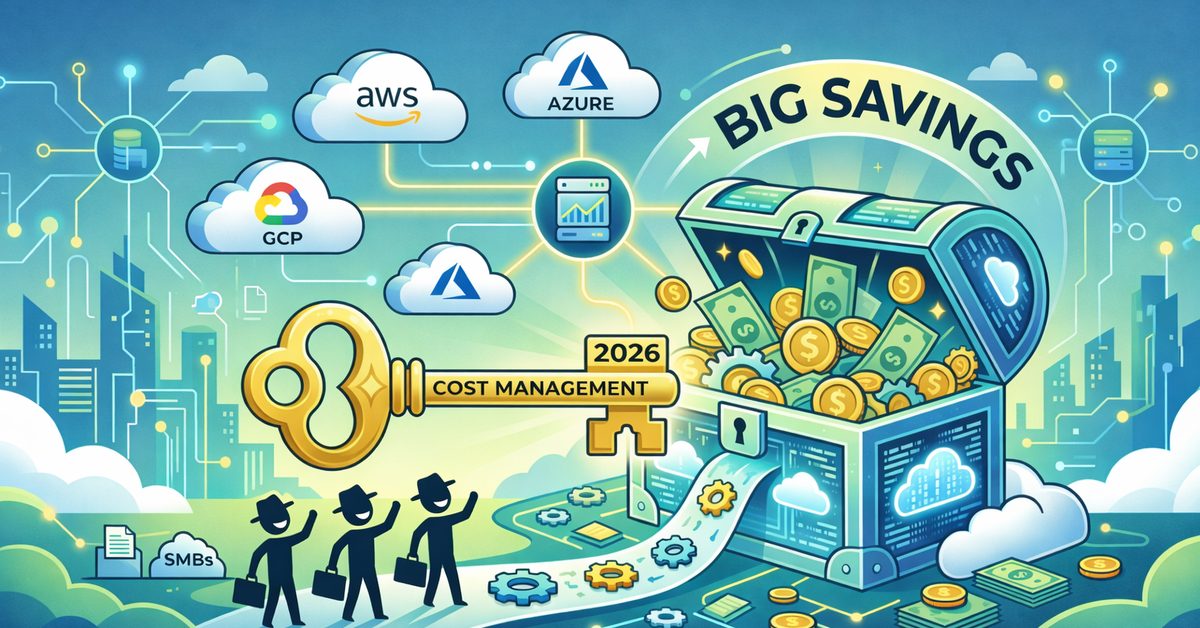
Ready to unlock big savings with smarter multicloud cost management for SMBs?
Gallop Technology Group can implement the plan with you—from first audit to ongoing operations—so you gain cost control, stronger security, and fewer surprises. Call our team at (480) 614‑4227 to schedule your free assessment.
Sources
- FinOps Foundation — Phases & Framework (Inform → Optimize → Operate): principles, lifecycle, and capabilities for cloud financial management. finops.org [finops.org]
- Microsoft — FinOps Framework overview: guidance aligned to the FinOps community for principles, scopes, lifecycle, and maturity. learn.microsoft.com [learn.microsoft.com]
- Microsoft Tech Community — FinOps hubs (multicloud cost reporting with FOCUS): unifying Azure and Google Cloud billing in a single hub. techcommunity.microsoft.com [techcommun…rosoft.com]

Frequently Asked Questions:
“Do we have to go all‑in on one cloud to save?”
No. Many SMBs stay multi‑cloud for good reasons (features, resilience, vendor leverage). What matters is having normalized cost data, tagging discipline, and a light governance loop so you can compare, decide, and act quickly. FinOps + FOCUS make multicloud manageable.
“We’re small—do we really need FinOps?”
Yes—scaled to your size. The FinOps Framework isn’t about bureaucracy; it’s about clarity, shared ownership, and frequent small adjustments. Those habits pay off whether you’re 10 people or 10,000.
“What kind of savings should we expect in year one?”
Results vary, but SMBs commonly see double‑digit reductions by combining cleanup, rightsizing, commitments for steady workloads, and SaaS rationalization—because these tackle the most common sources of waste. Industry data consistently shows cost control is a top challenge, and that waste (idle/oversized resources, unused SaaS) is pervasive—exactly where this plan focuses.