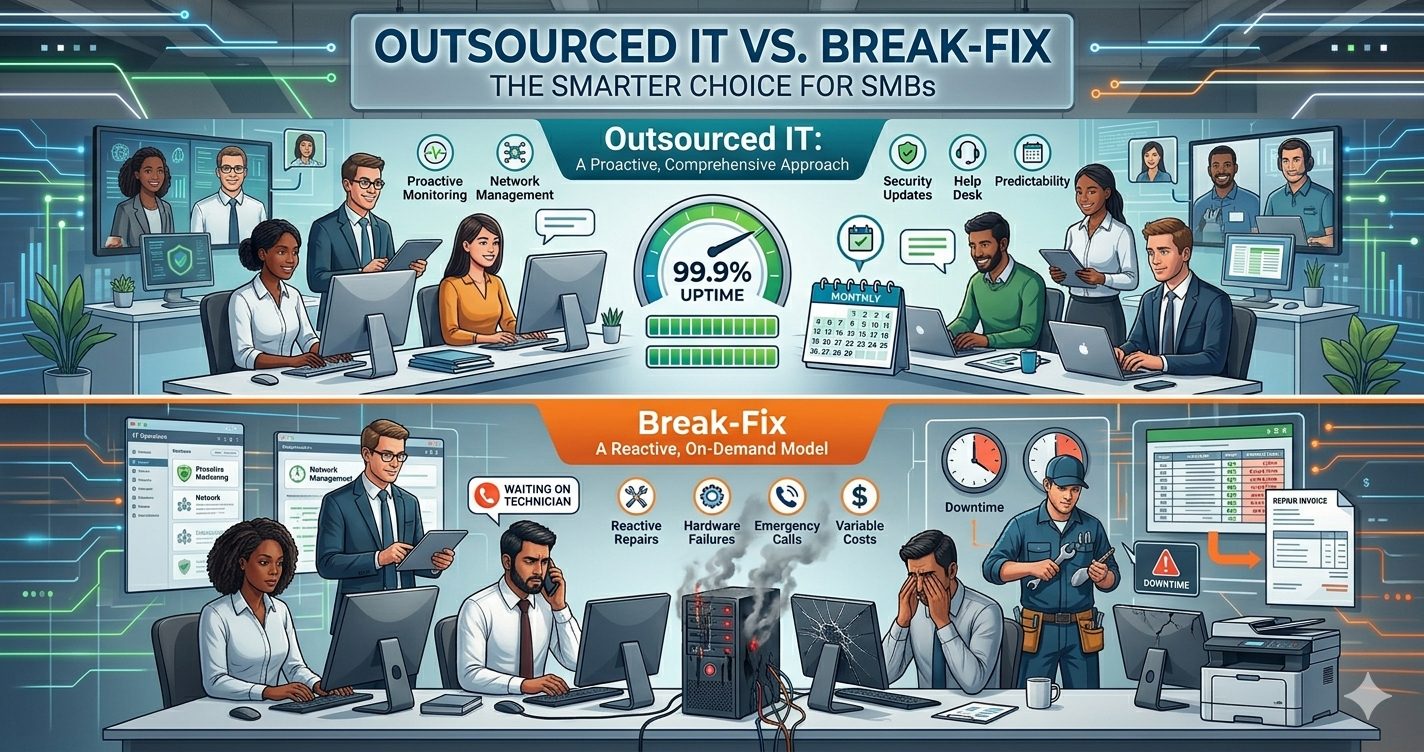
Outsourced IT vs Break-Fix: Cost, Risk, and Long-Term Value for SMBs
For many business owners, deciding between outsourced IT and break-fix support comes down to cost. At first glance, break-fix seems cheaper—you only pay when something goes wrong. But over time, the real cost of IT isn’t just about invoices. It’s about downtime, security risks, lost productivity, and missed opportunities. Understanding how these two models compare can help small and mid-sized businesses make a smarter, more strategic decision.
If you’re looking for a reliable, long-term approach to managing your technology, Gallop Technology Group works with businesses nationwide to provide proactive IT support, cybersecurity protection, and compliance guidance. Instead of reacting to problems, their approach focuses on preventing them—helping businesses stay productive, secure, and prepared for growth. Call our team now at 480-614 4227 to get your free IT assessment.
What Is Break-Fix IT Support?
Break-fix IT support is exactly what it sounds like: when something breaks, you call someone to fix it. There is no ongoing monitoring, maintenance, or strategic planning. You pay per issue, typically at an hourly rate.
For small businesses, this model can feel appealing because there are no monthly commitments. However, it also means there is no proactive effort to prevent issues. Systems are only addressed after they fail, which often leads to higher long-term costs.
In a break-fix environment, businesses are constantly reacting. Servers go down, employees can’t access files, or systems run slowly—and each time, it disrupts operations. There is also little visibility into the overall health of your IT environment, which increases the risk of larger, more expensive problems over time.
What Is Outsourced IT Support?
Outsourced IT support, often referred to as managed IT services, is a proactive approach. Instead of waiting for problems, an external provider continuously monitors, maintains, and improves your IT systems.
Businesses that invest in outsource IT services benefit from predictable monthly costs and ongoing support. This includes system monitoring, security updates, backups, and strategic guidance. Rather than focusing on fixing issues, the goal is to reduce or eliminate them altogether.
Working with experienced outsourced IT providers also gives small businesses access to a full team of specialists without the cost of hiring internally. This includes expertise in cybersecurity, cloud systems, compliance, and infrastructure planning.
For many organizations, especially those without internal IT teams, outsourced IT for small businesses provides a level of consistency and reliability that break-fix simply cannot match.
Cost Comparison: Short-Term Savings vs Long-Term Expense
At first glance, break-fix IT appears more affordable. There are no monthly fees, and you only pay when something breaks. However, this model often leads to unpredictable and escalating costs.
Each incident—whether it’s a server crash, network outage, or security issue—comes with its own expense. More importantly, the hidden costs can be far greater. Downtime can stop operations completely. Employees lose hours of productivity. Customer trust can be affected if services are disrupted.
In contrast, outsourced IT provides a predictable monthly investment. While there is an upfront commitment, the long-term financial impact is typically lower. Systems are maintained regularly, reducing the likelihood of major failures. Problems are identified early, before they turn into costly emergencies.
Over time, businesses often find that outsourced IT is not just more stable—but more cost-effective.
Risk Comparison: Reactive vs Proactive IT
One of the biggest differences between break-fix and outsourced IT is how each model handles risk.
Break-fix is reactive. Issues are addressed only after they happen. This creates gaps in security, maintenance, and monitoring. Without regular updates and oversight, systems become vulnerable to cyber threats, data loss, and compliance issues.
Outsourced IT, on the other hand, is built around prevention. Continuous monitoring helps detect unusual activity early. Regular patching ensures systems stay updated. Backup solutions protect critical data.
For small businesses, this proactive approach is critical. Cyber threats are no longer limited to large enterprises. In fact, smaller organizations are often targeted because they lack strong defenses. Working with experienced outsourced IT providers helps reduce this risk significantly.
Productivity and Operational Impact
Technology plays a central role in daily business operations. When systems fail, the impact is immediate.
In a break-fix model, downtime is unavoidable. Issues are discovered after they disrupt operations, and resolution depends on availability and response time. Employees may be unable to work, access systems, or communicate effectively.
With outsourced IT, systems are continuously monitored to minimize disruption. Potential issues are often resolved before users even notice them. This creates a more stable work environment where employees can focus on their tasks without constant interruptions.
Over time, this consistency leads to higher productivity and better overall performance.
Scalability and Business Growth
As businesses grow, their IT needs become more complex. New employees, new systems, and new processes require careful planning and support.
Break-fix IT does not provide a structured approach to growth. There is no long-term strategy, and decisions are often made reactively. This can lead to inefficiencies, compatibility issues, and increased costs.
Outsourced IT support includes strategic planning as part of the service. Businesses receive guidance on infrastructure, software, and security as they scale. This ensures that technology supports growth rather than holding it back.
For companies looking to expand, outsourced IT offers a more stable and scalable foundation.
Compliance and Security Considerations
Many industries have specific requirements for data protection and security. Failing to meet these standards can result in financial penalties and reputational damage.
Break-fix IT does not typically address compliance unless an issue arises. This leaves businesses exposed to potential risks.
Outsourced IT providers take a more structured approach. They help implement policies, monitor systems, and ensure that security measures are consistently applied. This is especially important for industries like legal, healthcare, and finance.
For businesses handling sensitive data, outsourced IT provides a level of oversight that break-fix cannot offer.

- Schedule time with me
The Hidden Cost of Waiting for Problems
One of the most overlooked aspects of break-fix IT is the cost of waiting. Waiting for something to break means accepting downtime, disruption, and potential data loss as part of normal operations.
This approach can also create stress for business owners and employees. There is always uncertainty about when the next issue will occur and how severe it will be.
Outsourced IT removes much of this uncertainty. With ongoing monitoring and maintenance, businesses gain more control over their technology environment. Issues are addressed early, and risks are managed proactively.
Why More SMBs Are Choosing Outsourced IT
Small and mid-sized businesses are increasingly moving away from break-fix IT in favor of outsourced solutions. The shift is driven by the need for reliability, security, and predictable costs.
With outsourced IT for small businesses, companies gain access to expertise, tools, and processes that would otherwise be difficult to build internally. This allows them to focus on their core operations while knowing their technology is being managed effectively.
The decision is no longer just about fixing problems—it’s about preventing them and supporting long-term growth.
Conclusion: Making the Smarter Choice
Choosing between break-fix and outsourced IT is ultimately a decision about how you want to run your business. One model reacts to problems. The other works to prevent them.
For most SMBs, outsourced IT offers a more stable, secure, and cost-effective approach. It reduces downtime, improves productivity, and supports growth. While break-fix may seem simpler in the short term, it often leads to higher costs and greater risks over time.
If your business is ready to move away from reactive IT and toward a more proactive strategy, Gallop Technology Group can help. Our team provides managed IT services, cybersecurity protection, and strategic guidance tailored to small and mid-sized businesses. Call us today at 480-614 4227 to discuss how outsourced IT can support your business goals.
Sources
Frequently Asked Questions:
What is the difference between outsourced IT and break-fix IT?
Outsourced IT provides proactive, ongoing support with continuous monitoring and maintenance, while break-fix IT is reactive and only fixes issues after they occur. The key difference is prevention versus repair.
Is outsourced IT more cost-effective than break-fix IT?
Yes, outsourced IT is generally more cost-effective over time. Break-fix IT may seem cheaper initially, but unexpected repairs, downtime, and security issues often lead to higher overall costs.
Why do small businesses choose outsource IT services?
Small businesses choose outsource IT services for predictable monthly costs, improved security, and access to expert support. It helps reduce risks while allowing business owners to focus on operations.
What are the risks of relying on break-fix IT support?
Break-fix IT increases the risk of downtime, data loss, and cyber threats because issues are only addressed after they occur. This reactive approach can disrupt operations and increase long-term expenses.
Is outsourced IT for small businesses a good option without an internal IT team?
Yes, outsourced IT for small businesses is ideal for companies without internal IT staff. It provides full support, cybersecurity protection, and strategic guidance without the cost of hiring in-house employees.